Houseplant Light: Find a Suitable Spot Beyond the Window Label
Bright indirect light means a well-lit position where strong sunbeams are not falling directly on the leaves. A room that looks bright to you can still have a dim plant shelf. Start with the species’ needs and inspect the actual position; a window direction alone cannot tell you whether it is suitable.
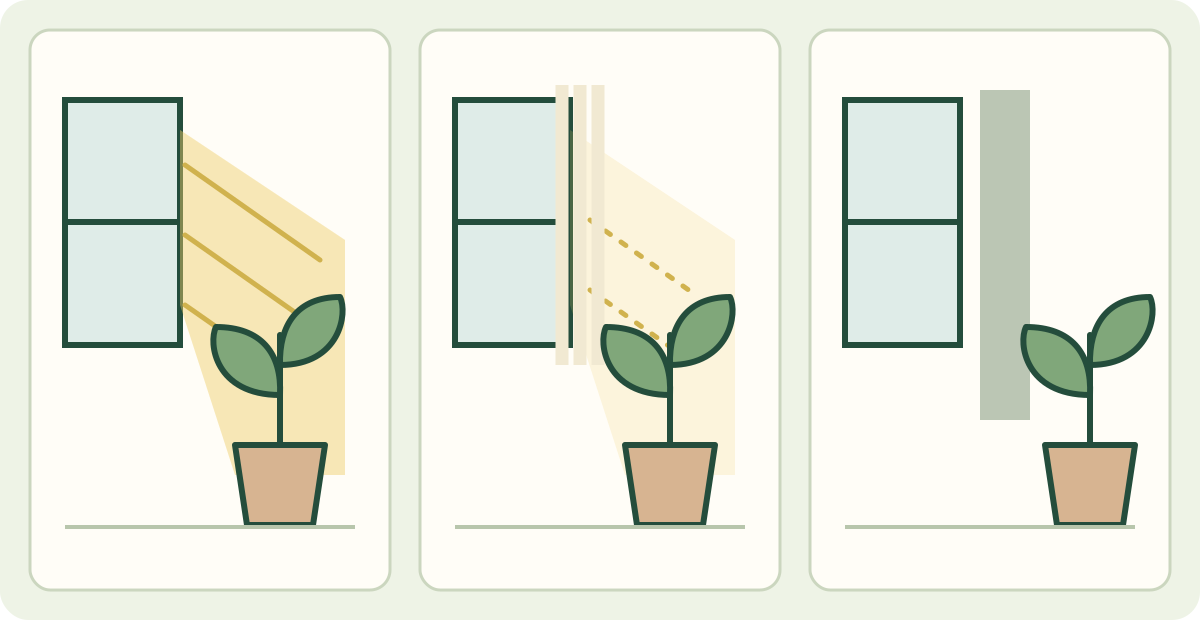
From left to right: direct sun, filtered light and an obstructed position. These are different exposures, not three equally suitable homes for the same plant.
Map the light where the leaves sit
N.C. Cooperative Extension distinguishes direct sun from bright indirect light and explains how buildings, trees and distance change exposure. Window glass alone does not make a sunbeam indirect.
Check the proposed spot in the morning, around midday and later in the day. Record whether sunlight reaches the foliage, how long it stays and what blocks the sky. Check at leaf height, including a trailing plant’s lower leaves, rather than judging from the middle of the room.
| What you observe | What it tells you to check |
|---|---|
| A sunbeam crosses the leaves | Whether the species and its current acclimation suit direct sun |
| A sheer curtain softens the light | Whether enough light remains after filtering |
| A shelf sits behind a wall or deep recess | How much sky the plant can actually receive light from |
| Conditions change with the season | Whether the previous position still meets the plant’s needs |
There is no reliable distance from a window that works for every window, climate and plant. North- and south-facing advice also changes with hemisphere and latitude; nearby obstructions can outweigh the compass direction.
Read new growth without treating it as a diagnosis
Longer gaps between leaves, weak stretching and smaller new leaves can justify reviewing light. Bleached or scorched areas after a move can justify checking excessive exposure. Minnesota Extension describes responses to insufficient and excessive light.
These clues overlap with other problems. A yellow leaf alone does not prove a lighting issue, and a plant tolerating low light is not a plant that needs no light. Compare moisture, temperature and pests before making several changes at once.
Change the position gradually
If more light is appropriate, avoid moving a plant straight from a dim corner into intense sun. Increase exposure gradually and watch the new growth. Keep foliage away from hot or cold glass and direct heater airflow. Cleaning dusty, smooth leaves can help light reach the surface; use the leaf-cleaning guide to choose a suitable method.
If every available spot is too dark, choose a plant suited to the conditions or investigate supplemental lighting. Fertilizer cannot replace light, so review when feeding is useful before increasing it.
Keep a placement record
Example only: “Desk shelf; no direct sun; neighboring building blocks the afternoon sky; moved nearer the window gradually.” Add a photo from the same angle and note subsequent growth. A care journal makes this comparison easier. Recheck watering after a move: light and drying can change together, as explained in the winter watering guide.