How to Propagate Pothos: Find a Node, Root a Cutting and Pot It
Propagate pothos (Epipremnum aureum) from a healthy stem cutting that includes at least one node. A leaf blade and its stalk without a piece of nodal stem cannot produce a new pothos vine. You can root a suitable cutting in water or a moist, airy propagation mix; choose the route you can monitor consistently.
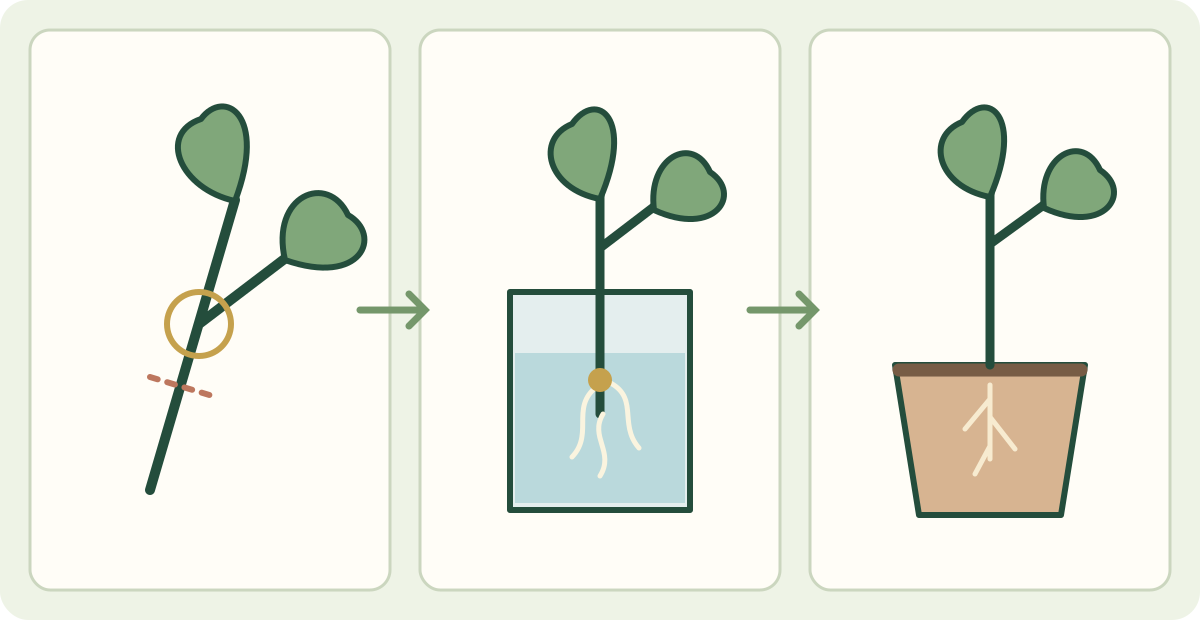
Left to right: keep the node, root the cutting, then pot the roots. The highlighted ring marks the node; the diagram is schematic, not a rooting trial.
Find the node before making the cut
A node is the point on the main vine where a leaf attaches and a bud or aerial-root bump may be visible. The leaf stalk itself is not the main stem. Clemson Extension confirms that a pothos stem cutting needs a node and can root in soil or water.
Choose firm, healthy material from a plant without an active pest problem. Clean the scissors and container first. Cut below a node so it remains on the cutting, and remove any leaf that would sit under water or inside the rooting mix. Retain upper foliage. Keep cuttings out of reach of children and pets, as the Clemson guide notes pothos is harmful if ingested.
Choose water or mix deliberately
| Route | What to do | What to watch |
|---|---|---|
| Water | Submerge the bare node in a clean container; keep leaves above water | Maintain the water level, replace cloudy water and inspect for soft tissue |
| Propagation mix | Place the node in a premoistened, airy medium in a draining container | Keep it moist without saturation; do not repeatedly pull the cutting up |
Place either route in bright indirect light with stable warmth. A jar in hot sun is not a shortcut to faster roots. Illinois Extension’s propagation guide explains clean preparation, moisture management and the fragility of new roots.
Rooting speed varies with the cutting and conditions. Do not discard a firm cutting solely because an online deadline has passed. Conversely, a collapsing, soft or foul-smelling cutting needs assessment rather than more waiting. Remove rotting material; if no healthy node remains, start with a fresh cutting.
Move rooted cuttings without overwhelming the roots
For a water-rooted cutting, wait for several healthy roots rather than one tiny initial bump. Choose a small pot with drainage and an airy mix, make room for the roots and settle them gently without breaking them. A large display pot leaves unnecessary wet mix around a small root system.
Water to settle the mix and let excess drain. Check moisture closely during establishment: keep the root zone from drying out completely while avoiding waterlogging, then adapt toward ordinary pothos care as growth establishes. Do not copy the watering interval from the mature parent plant or add extra fertilizer to hurry the transition.
Record progress, not a promised success date
Label the cutting with its start date and route. Example only: “Node submerged, leaves clear of water; cutting firm; no roots visible yet.” Use photos taken without repeatedly handling the roots. A plant care journal helps keep separate cuttings distinct.
For the established plant, return to the pothos care overview. If a newly potted cutting droops, check the mix and roots before using the after-potting checks; it has less root capacity than an established plant.